




How to Become a Veterinary Ophthalmologist: Complete Career Path Guide
Eye diseases in pets are more common than most pet owners realize. And when an ophthalmic case is too complex for a general practitioner, it lands on the desk of a veterinary ophthalmologist.
If you want to specialize in animal eye care, you must navigate a highly competitive, multi-year pipeline.
This guide explains what a veterinary ophthalmologist is, what they do, the education and training required, how long the career path takes, and what salary you can expect.
What is a Veterinary Ophthalmologist?
A veterinary ophthalmologist is a licensed veterinarian who has completed residency training and board certification focused entirely on the health of animal eyes.
In the United States, board certification is administered by the American College of Veterinary Ophthalmologists (ACVO), a specialty organization recognized by the American Board of Veterinary Specialties (ABVS). Veterinarians who successfully complete residency training and pass the ACVO certifying examination earn Diplomate status (DACVO).
Veterinary Ophthalmologist Job Description
The typical veterinary ophthalmologist job description covers both medical and surgical cases of the eye across multiple species. While most clinical work involves companion animals, these specialists treat a wide range of patients.
These veterinary eye specialists diagnose and treat complex ocular diseases and disorders, such as cataracts, glaucoma, corneal ulcers, uveitis, retinal disease, and eyelid tumors.
Common veterinary ophthalmologist duties include:
- Performing advanced diagnostic procedures like tonometry (measuring intraocular pressure), slit-lamp biomicroscopy, and electroretinography (testing retinal function).
- Conducting microsurgeries, such as cataract extraction using phacoemulsification, corneal grafting, and eyelid reconstruction.
- Developing medical treatment plans for chronic, painful eye conditions like dry eye (keratoconjunctivitis sicca) and glaucoma.
- Consulting with referring general practice veterinarians to co-manage complex systemic diseases that manifest in the eye.
- Conducting genetic screening eye exams for breeding animals to prevent inherited ocular diseases.
Ophthalmic microsurgery requires exceptional manual dexterity, patience, and the ability to work comfortably under a high-powered operating microscope.
Veterinary Eye Specialists: Canine Ophthalmologist and Beyond
While a board-certified specialist is trained to treat all animal species, the vast majority of cases in private referral practice involve companion animals or pets.
Because dogs are genetically predisposed to a long list of inherited eye conditions (such as cherry eye, progressive retinal atrophy, and distichiasis), the demand for canine ophthalmologists is very high.
However, the clinical scope for veterinary ophthalmology is diverse. Depending on the practice, a specialist might treat a horse with a complex corneal ulcer, perform cataract surgery on a valuable zoo animal, or manage uveitis in a cat.
Veterinary Ophthalmologist Education Requirements
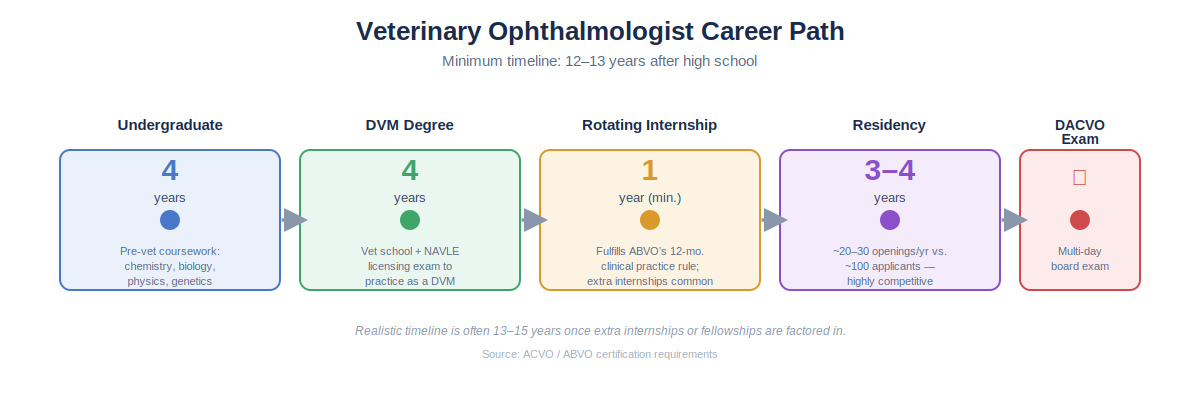
The veterinary ophthalmologist education requirements demand strong commitment. The academic and clinical pathway consists of five key phases:
1. Undergraduate Preparation
Veterinary ophthalmologist training begins with undergraduate studies. Although there is no required major, most pre-veterinary coursework is geared toward organic chemistry, biochemistry, advanced biology, physics, and genetics
2. The DVM Degree
You must earn a Doctor of Veterinary Medicine (DVM) or equivalent degree from an accredited college of veterinary medicine. The degree involves four years of study of general anatomy, pharmacology, pathology, and surgery of animals. To be able to legally practice as a veterinarian, it is necessary to pass the North American Veterinary Licensing Examination (NAVLE) during this phase.
3. General Clinical Internship
A one-year rotating internship in small animal or large animal medicine and surgery is the standard next step before applying to a specialty residency. This stage combines broad clinical practice with hands-on training and, critically, it's how most candidates fulfill ABVO's requirement of a minimum of 12 months of full-time clinical practice as a licensed veterinarian — a prerequisite for eventual board certification, separate from the residency itself.
Because ophthalmology residency positions are competitive (ACVO reports roughly 20 to 30 openings each year against around 100 applicants), many candidates strengthen their applications with one or more additional specialty internships or research fellowships in ophthalmology before applying to a residency. Each of these is typically a one-year commitment.
4. Specialized Veterinary Ophthalmologist Training (Residency)
After your internship, you will have to find and complete a residency program with the approval of ACVO. It is an intensive course and will take 3-4 years to complete with direct supervision from board-certified Diplomates of the ACVO (DACVO).
5. Veterinary Ophthalmologist Certification
The final step is passing the ACVO certifying examination. This multi-day credentialing exam includes comprehensive written, practical, and surgical testing components. Passing this exam grants you veterinary ophthalmologist certification, earning Diplomate status in the American College of Veterinary Ophthalmologists (DACVO).
How Long Does It Take to Become a Veterinary Ophthalmologist?
Becoming a veterinary ophthalmologist takes a minimum of 12 years after high school.
If you are planning your timeline, you must prepare for a long-term academic commitment.
|
Educational Stage |
Duration |
|
Undergraduate Studies |
4 years |
|
Veterinary School (DVM) |
4 years |
|
Rotating Internship |
1 year |
|
Ophthalmology Residency |
3 to 4 years |
|
Minimum Total Timeline |
12 to 13 years |
Many candidates don't move straight from internship to residency. Because residency spots are limited and competition is high, it's increasingly common to complete one or more additional specialty internships or research fellowships in ophthalmology first — each typically adding a full year.
Candidates who complete one extra preparatory year should plan for a realistic timeline of 13 to 14 years; those who complete two should plan for 14 to 15 years. Treat 12 years as the fastest possible path, not the typical one.
Veterinary Ophthalmologist Salary: What to Expect
The payback for this educational investment is good. Board-certified specialists are in high demand, and that scarcity supports strong compensation.
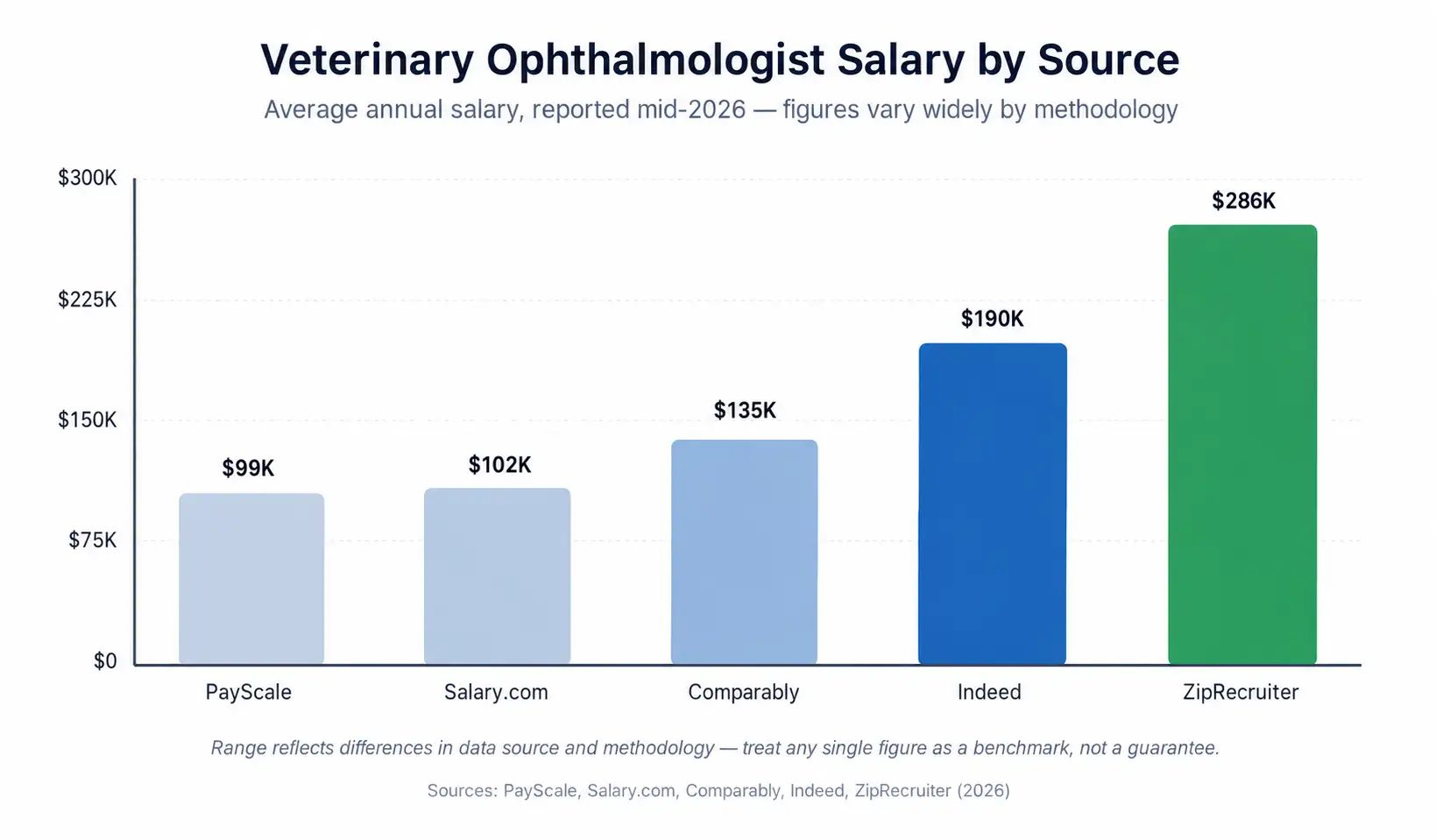
Reported salary figures for veterinary ophthalmologists vary significantly depending on the data source, methodology, and whether the figure reflects base salary, total compensation, or self-reported survey data. As of mid-2026:
- Indeed reports an average of approximately $190,000 per year, based on recent job postings
- ZipRecruiter reports a considerably higher average of roughly $286,000 per year, with a typical range of about $250,000 to $326,500
- Other salary-aggregation sites report lower figures, in some cases under $150,000, likely reflecting different underlying data sets or job-title matching
In many private practices, veterinary eye specialists are hired on a production basis (sometimes called a Pro-Sal position). Under this model, specialists earn a percentage of the revenue generated from the diagnostics and surgeries they perform, which can substantially increase their overall income above a flat base salary.
Career Opportunities for Veterinary Eye Specialists
The practice of veterinary medicine for eye disease is a very limited specialty, and there are relatively few board-certified veterinary ophthalmologists available to provide this specialty care. That’s why the demand for animal eye specialists is high.
The veterinary ophthalmologist career opportunities include:
- Veterinary Eye Specialist: Working as a veterinary ophthalmologist at a private specialty hospital or eye clinic.
- Academic Researcher: Conducting clinical research at academic institutions.
- Lecturer: Teaching and mentoring residents
- Veterinary Medical Advisor (Ophthalmology): Working with veterinary pharmaceutical companies, medical device manufacturers, or biotechnology firms to develop new eye therapies.
- Veterinary Ophthalmology Consultant: Once you've completed residency and earned board certification, you can browse current veterinary jobs to see which specialty hospitals, referral centers, and academic institutions are actively hiring.
What are the typical work environments for veterinary ophthalmologists?
Most board-certified veterinary ophthalmologists work in private specialty or referral hospitals and dedicated veterinary eye clinics, seeing cases referred by general practitioners. Others work in academic settings at veterinary schools, combining clinical caseload with teaching and mentoring residents.
Some pursue industry roles as medical advisors for veterinary pharmaceutical, device, or biotech companies, while others operate as independent consultants providing mobile ophthalmic services to general practices within a region.
Specialized Training in Veterinary Ophthalmology by Vet and Tech
Vet and Tech provides RACE-approved free CE education. The courses are designed for veterinary professionals who want to stay updated with advanced clinical procedures.
Vet and Tech offers educational content covering veterinary ophthalmology and eye surgery.
These educational sessions will help reinforce your clinical knowledge throughout your veterinary career, from a foundational perspective to diagnostic techniques to case-management strategies.
To get one free RACE-approved CE credit in veterinary ophthalmology now, check out the on-demand webinar on the subject of ocular emergencies in veterinary medicine.
Whether you are a veterinary student preparing for your DVM, a general practitioner managing primary eye cases before referral, or a veterinary technician assisting in microsurgery, staying updated on ocular medicine is essential.
Conclusion
It takes a great deal of commitment to become a veterinary ophthalmologist: more than a decade of study and training, and often longer once competitive preparatory years are factored in. There's a long road from pre-vet to ABVO board certification, but it's a rewarding career to follow when it comes to veterinary jobs.
You will be helping your patients see again, alleviate chronic pain, and drastically improve their lives.
If you are interested in pursuing this clinical specialty, then the career and income will make it well worth your journey. Once you're ready to start applying, our guide to veterinary interview questions and how to answer them can help you prepare, since even highly specialized roles still involve a standard interview process.


%20VAT%20Blog%20-%20Remote%20Veterinary%20Jobs%20Roles%2C%20Pay%20%26%20How%20to%20Find%20Them-thumbnail-1790256372.webp&w=3840&q=75)