

Cat Abscess Healing Stages: Causes, Symptoms & Veterinary Treatment
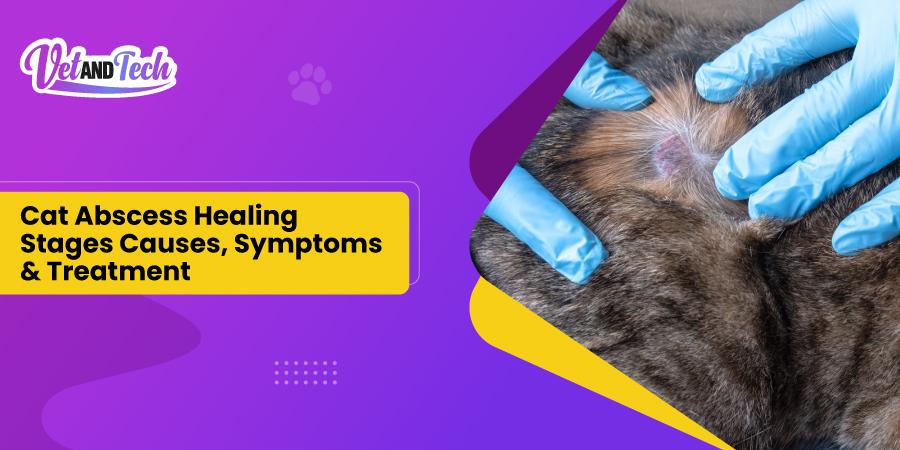
A cat abscess heals in five stages: early inflammation in the first 24 hours after bacteria enter the skin, abscess maturation over two to five days as pus collects inside a fibrous capsule, rupture or veterinary drainage, granulation and wound contraction over one to two weeks, and final tissue remodeling with hair regrowth over several more weeks.
Most cats are visibly more comfortable within 24 to 48 hours of adequate drainage, and most wounds close within one to three weeks.
Cat abscesses are one of the most common presentations in small animal practice and usually follow a bite wound, scratch, or puncture injury. Recognizing which stage a cat is in helps determine whether drainage is needed now, whether antibiotics are indicated, and when a case is not progressing as expected.
What Are Cat Abscesses?
Cat abscesses are painful, pus-filled pockets that develop beneath the skin. Abscesses are localized subcutaneous infections due to bacteria entering the tissue through a bite wound, scratch, or other skin lesion. In reaction, the immune system sends white blood cells to attack the infection. The body walls off the infection and dead white blood cells, bacteria, and damaged tissue accumulate to form pus.
Abscesses are one of the most common presentations seen in small animal practice, particularly in intact male cats with outdoor access.
Bacteria commonly involved
Cat bite wounds inoculate oral flora deep into tissue, which is why these infections are typically mixed and often anaerobic:
- Pasteurella multocida, the organism most frequently isolated from cat bite wounds
- Bacteroides species
- Fusobacterium species
- Porphyromonas species
- Beta-hemolytic Streptococcus species
- Staphylococcus species
- Actinomyces species, more often in penetrating plant material cases
Knowing the usual flora explains why amoxicillin-clavulanate remains a sound empirical first choice and why coverage limited to gram-positive organisms is often inadequate.
Common Causes of Cat Abscesses
Although bacterial infection is the direct cause of feline abscesses, several factors can allow bacteria to enter the tissue and trigger an infection.
Bite wounds from other cats are the most common cause of abscesses because bacteria are carried deep beneath the skin. Bite wounds are also the primary route of transmission for feline immunodeficiency virus (FIV), making cats involved in frequent fights more vulnerable to both abscesses and viral infection.
Some common causes of cat abscesses are as follows:
- Animal Fights and Territorial Disputes
- Puncture Wounds
- Injection Site Infection
- Insect Bites
- Flea and Tick Bites
- Grass Awns and Plant Material
- Dental Infections
- Anal Sac Infection
- Ingrown Hair
- Foreign Objects
- Surgical or Traumatic Wounds
- Weakened Immune System
Outdoor cats and intact males involved in territorial fights carry the highest lifetime risk, though indoor cats are not immune, particularly in multi-cat households with unresolved social tension. Cats with feline leukemia virus (FeLV) have a weakened immune system, which makes it harder to fight bacterial infections and may increase the risk of abscess formation. On the other hand, cats diagnosed with feline infectious peritonitis (FIP) often have altered immune responses, which can make managing bacterial infections more challenging.
Symptoms of Cat Abscesses
Early abscesses are easy to miss because the entry wound usually seals within about 24 hours and is hidden by fur. Signs reported by owners or found on physical examination include:
- A firm, warm swelling that becomes fluctuant as fluid accumulates
- Pain on palpation, and resentment of handling over the area
- Fever, commonly in the 102.5 to 104°F (39.2 to 40°C) range, higher with significant systemic involvement
- Purulent discharge, sometimes noticed only once the abscess has started to drain
- Matted, damp fur and a foul odor over the site
- Lameness or reluctance to bear weight when the abscess involves a limb
- Behavioral changes including hiding, reduced appetite, lethargy, or aggression when touched
Because the original injury often goes unnoticed, a cat with a ruptured abscess frequently presents with the owner describing a wound that appeared overnight.
Cat Abscess Healing Stages
Knowing the stages of a cat's abscess can be helpful to veterinarians in determining when to intervene (drainage, antibiotics, surgery) and when it can heal on its own.
Here are the stages of cat abscesses.
Stage 1: Early Inflammation (0 to 24 hours)
In stage 1, bacteria are introduced into the subcutaneous tissue through a cut or wound on the skin. The surface wound seals within 24 hours, trapping the bacteria beneath the skin. The immune response sends white blood cells to fight the infection, due to which early inflammation appears on the cat's skin. Cats at this stage may show only mild, easily overlooked signs, such as slight sensitivity to touch.
Stage 2: Abscess Maturation (2 to 5 days)
Over roughly two to five days, the immune system walls off the infection with a fibrous capsule, and pus accumulates within that cavity. This is when the classic firm, painful swelling becomes obvious. Cats at this stage may show lethargy accompanied by fever. Abscess maturation is the stage at which most owners first notice something is wrong.
Stage 3: Abscess Rupture and Drainage
At stage 3, the internal pressure of the fibrous capsule increases and the abscess ruptures. In cats, abscesses can burst on their own or are lanced by a veterinarian.
Rupture and drainage relieve the pressure and let the purulent material escape. Cats generally have rapid symptomatic improvement in comfort and appetite 24 to 48 hours after adequate drainage, even before the wound itself has closed.
Stage 4: Granulation and wound contraction (1 to 2 weeks)
The wound contracts slowly as healthy granulation tissue fills the cavity. New skin grows over the healed tissue. The discharge slowly diminishes. If needed, antibiotics may help control any remaining bacterial infection. Wound care is important to keep the area clean as it continues to recover.
Stage 5: Tissue remodeling and hair regrowth (several weeks)
New tissue regenerates, and fur starts to regrow over time as the site continues to remodel. Full cosmetic recovery, including complete hair regrowth, typically takes several additional weeks beyond wound closure and depends on the size, depth, and location of the original abscess.
What Else Looks Like an Abscess
Not every subcutaneous swelling is an abscess, and a few differentials change the plan significantly:
- Hematoma or seroma, particularly after trauma or surgery
- Epidermal inclusion cyst, non-painful and slow growing
- Foreign body granuloma
- Eosinophilic granuloma complex lesions
- Neoplasia, including mast cell tumor and soft tissue sarcoma
- Feline injection-site sarcoma, which deserves specific attention for any firm mass at a previous injection site that persists beyond three months, exceeds 2 cm, or continues to enlarge
- Mycobacterial or fungal infection, which should be considered in any draining tract that fails to resolve on appropriate antibiotics
Fine needle aspiration is quick, inexpensive, and usually distinguishes these. Any non-healing lesion warrants cytology, culture, and often biopsy rather than a further course of antibiotics.
Feline Abscess Veterinary Treatment
The treatment of the abscesses in cats depends on the size and location of the infection. Most abscesses are treated by lancing and draining the infected cavity. Medications include antibiotics (to fight the infection) and analgesics.
To promote healing of the abscess in cats, warm compresses and e-collars are suggested by the veterinarians. Common medications used to treat cat abscess infections are clindamycin and amoxicillin-clavulanate.
If the abscess in cats has progressed into a serious case, surgical interventions are also considered to clean deep wounds and remove damaged tissue.
How Veterinarians Treat an Abscess on a Cat:
Drainage is the definitive treatment. Antibiotics support it but do not replace it, since systemic drugs penetrate an encapsulated pus pocket poorly.
Drainage and wound management:
- Sedation or general anesthesia. These wounds are painful and almost always more extensive beneath the skin than the surface suggests.
- Clipping and aseptic preparation of a generous margin around the site.
- Lancing at the most dependent point so gravity assists ongoing drainage.
- Digital exploration and debridement of pockets, necrotic tissue, and any foreign material.
- Copious lavage with sterile saline or a dilute antiseptic solution to reduce bacterial burden.
- Establishing continued drainage, either by leaving the wound open to heal by second intention or placing a Penrose drain for 2 to 4 days in deeper, recurrent, or heavily undermined cases.
Antibiotic selection
Empirical treatment should cover Pasteurella and anaerobes. Amoxicillin-clavulanate is the usual first choice. Clindamycin is a reasonable alternative with good anaerobic and bone penetration, and cefovecin is useful where oral dosing compliance is a barrier. Courses of 7 to 14 days are typical, extended in deep or complicated infections.
Culture and sensitivity testing is indicated for recurrent cases, cases not responding as expected, abscesses in unusual locations, and any wound with a persistent draining tract, since resistant organisms do occur.
Analgesia
Cat abscesses are painful and analgesia should not be treated as optional. Buprenorphine is commonly used for acute pain around drainage, with an NSAID such as robenacoxib or meloxicam added once hydration and renal function are confirmed adequate. Multimodal analgesia improves comfort and reduces self-trauma to the wound.
Additional considerations
- Retest for FIV and FeLV approximately 60 days after a known bite wound, since seroconversion takes time and a negative test at presentation does not rule out exposure.
- Review vaccination and parasite prevention status while the cat is in the clinic.
- Recommend neutering for intact males, which is the single most effective intervention for reducing repeat fight wounds.
Possible Complications
Most cases resolve without incident, but delayed or inadequate treatment can lead to:
- Cellulitis, with diffuse spreading inflammation rather than a discrete pocket
- Septic arthritis or osteomyelitis when a bite penetrates a joint or overlies bone, most often on distal limbs
- Pyothorax, which should be considered after thoracic bite wounds and in any cat with dyspnea following a fight
- Sepsis, requiring hospitalization, intravenous fluids, and parenteral antibiotics
- Recurrence at or near the original site, which points to retained foreign material, an incompletely drained pocket, or underlying immunosuppression
Managing Cat Abscesses at Home
Most cat abscesses heal well when treated promptly with drainage, wound care, and any prescribed medications. Delaying treatment can allow the infection to spread and lead to more serious problems.
- To support healing, pet parents should:
- Keep the wound clean and follow the veterinary instructions for home care.
- Give all prescribed medications exactly as directed, even if the cat seems better.
- Prevent the cat from licking or scratching the wound by using an Elizabethan collar if recommended.
- Attend follow-up visits so the veterinarian can check that the wound is healing as expected.
- Keep the cat indoors until the wound has healed to reduce the chance of contamination or another fight.
Contact the veterinarian if you notice increasing swelling, persistent discharge, a foul odor, fever, loss of appetite, lethargy, or if a new swelling develops near the original site. Recurrent abscesses may point to an underlying problem that needs further investigation.
Cats with spreading skin infections, known as cellulitis, or signs of a body-wide infection, such as sepsis, need urgent veterinary care. If a wound fails to heal despite appropriate treatment, your veterinarian may recommend additional tests, including a biopsy, to rule out conditions such as cancer or fungal infections.
Conclusion
Cat abscesses are a common medical condition that is treatable if detected early and treated properly. While many begin as minor bite wounds or scratches that go unnoticed, the infection beneath the skin can spread fast if left untreated.
Understanding the healing processes, seeing warning signals, and knowing when to seek veterinary treatment can minimize pain, accelerate healing, and lower the risk of complications.
With proper drainage, suitable medications, and continuous wound care at home, most cats recover completely within a few weeks. Regular follow-up visits, completing the prescribed therapy, and keeping cats indoors during recovery all play a part in preventing recurrence and encouraging a smooth return to regular activities.
Frequently Asked Questions:
1. How long does it take for a cat abscess to heal?
Most cat abscesses begin improving within 24 to 48 hours after proper drainage and treatment. Complete healing usually takes 1 to 3 weeks, depending on the size and location of the abscess, the cat's overall health, and whether antibiotics or surgery are required.
Larger or deeper abscesses may take longer to heal and should be monitored by a veterinarian.
2. Can a cat abscess heal without antibiotics?
Some small abscesses may heal after they rupture and drain naturally, but many cat abscesses require veterinary treatment. Antibiotics are often prescribed when there is significant infection, surrounding cellulitis, fever, or a weakened immune system.
A veterinarian will determine whether antibiotics are necessary based on the severity of the infection and the cat's overall condition.
3. What should I do if my cat's abscess bursts at home?
If a cat's abscess ruptures, gently keep the area clean using warm water or a veterinarian-approved saline solution. Do not squeeze the wound or apply human antiseptics unless instructed by your veterinarian.
Because bacteria can remain trapped beneath the skin, your cat should be examined promptly to determine whether drainage, antibiotics, pain relief, or additional wound care is needed.
4. Can a cat abscess come back after treatment?
Yes. A cat abscess can recur if the original infection is not completely resolved, if another bite or puncture wound occurs, or if an underlying condition weakens the immune system.
Keeping cats indoors, preventing fights, completing all prescribed medications, and attending follow-up veterinary visits can significantly reduce the risk of recurrence.
%20VAT%20Blog%20-%20How%20to%20Become%20a%20Relief%20Veterinarian-thumbnail-1788963604.webp&w=3840&q=75)