




Point-of-Care Diagnostics vs. Reference Laboratory Testing: When Should Veterinarians Choose Each?
You have the patient on the exam table in critical condition. The owner is anxious and you have to choose which diagnostic approach could give you faster results. Do you do the blood work in-house or send it to a reference lab? That one decision affects your clinical workflow, client communication, and the care your patients receive.
Understanding when to use in-clinic testing and when to rely on a reference laboratory, rather than treating them as competitors, can help create a more efficient diagnostic workflow.
In this article, we'll look at when in-clinic testing makes the most sense, when a reference laboratory is the better choice, and how the two work together in everyday practice.
What Veterinary POC Tests Actually Offer
|
Factor |
POC Testing |
Reference Laboratory |
|
Turnaround time |
Minutes to hours |
Often longer |
|
Location |
In-clinic |
External laboratory |
|
Best for |
Urgent decisions & monitoring |
Specialized & confirmatory testing |
|
Test menu |
Limited to available analyzers |
Broader range |
|
Clinical use |
Immediate decision-making |
Comprehensive diagnostics |
|
Workflow |
Results available at point of care |
Requires sample submission |
Point-of-care diagnostic analyzers can be easily utilized in a treatment room right beside your patient. Results are available within minutes rather than days.
The diagnostics used in veterinary clinics have expanded far beyond the basic chemistry panel. Today’s veterinary diagnostic tools include blood gas and electrolyte analysis, coagulation panels, infectious disease screening, hormone assays, and more. This broader menu means in-house veterinary diagnostic testing can now support real-time decision-making across emergency medicine, surgery, and even routine wellness visits.
The clinical value of veterinary point-of-care testing is most evident in several scenarios:
- Emergency and critical care: Cases where minutes matter. A vomiting, lethargic patient with suspected pancreatitis or a toxin ingestion cannot wait 24 to 48 hours for answers.
- Surgical monitoring: Where intraoperative blood gas or electrolyte values guide anesthesia and fluid decisions in real time.
- Same day treatment decisions for chronic disease management, such as adjusting insulin dosing after a quick glucose curve.
- Client-facing situations where immediate answers build trust and support compliance with recommended follow-up care.
Where Veterinary POC Test Accuracy Can Be a Concern
Veterinary POC test accuracy has improved substantially with newer-generation analyzers, but it still varies by test type, sample handling, and calibration frequency.
Rapid diagnostic tests that veterinary teams use daily are generally reliable for trending values and urgent triage, but some assays remain more susceptible to interference from lipemia, hemolysis, or low sample volume than their laboratory counterparts.
This is where using POC testing becomes as much about clinical judgment as it is about technology. A skilled clinician learns which in-house results can guide immediate decisions and which warrant confirmatory testing send-out, especially for values that will drive a major treatment decision or a client conversation about prognosis.
When Reference Laboratory Testing Still Wins
Reference laboratories still offer a wider range of tests and more advanced analytical capabilities than any benchtop analyzer.
Reference testing is the preferred option for:
- Advanced endocrine tests or special infectious disease titers (complex or rare panels).
- Cases where highly specialized or validated testing is required, particularly when results will influence complex or high-risk clinical decisions.
- Highly standardized and validated results are more valuable than rapid turnaround, particularly when establishing baseline values or monitoring long-term trends.
- Cases where independent laboratory results are preferred, such as insurance claims or legal documentation.
Larger validated instrument platforms, stringent quality-control protocols, and access to specialized assays can make reference testing the better choice in these situations.
Building a Balanced Diagnostic Strategy
The strongest diagnostic strategy is not about choosing between POC testing and reference laboratories.
It is about using both intentionally. Veterinary diagnostic tests split naturally into two tiers: those that answer "what do I need to know right now?" and those that answer "what do I need to confirm with certainty?"
A practical framework many clinics use is:
- Use POC testing for triage, monitoring trends, and decisions that cannot wait for reference laboratory results.
- Prefer reference laboratory testing to confirm any POC result that will drive a major or irreversible treatment decision.
Reassess your veterinary POCT menu periodically as new analyzers and assays enter the market, as the capabilities of in-house testing continue to expand across many diagnostic panels.
Train the whole clinical team, not just doctors, on sample handling for both pathways, since pre-analytical error is still the single biggest driver of inaccurate results in either setting.
Learn About POC Diagnostics at Vet and Tech's Rapid Testing Webinar
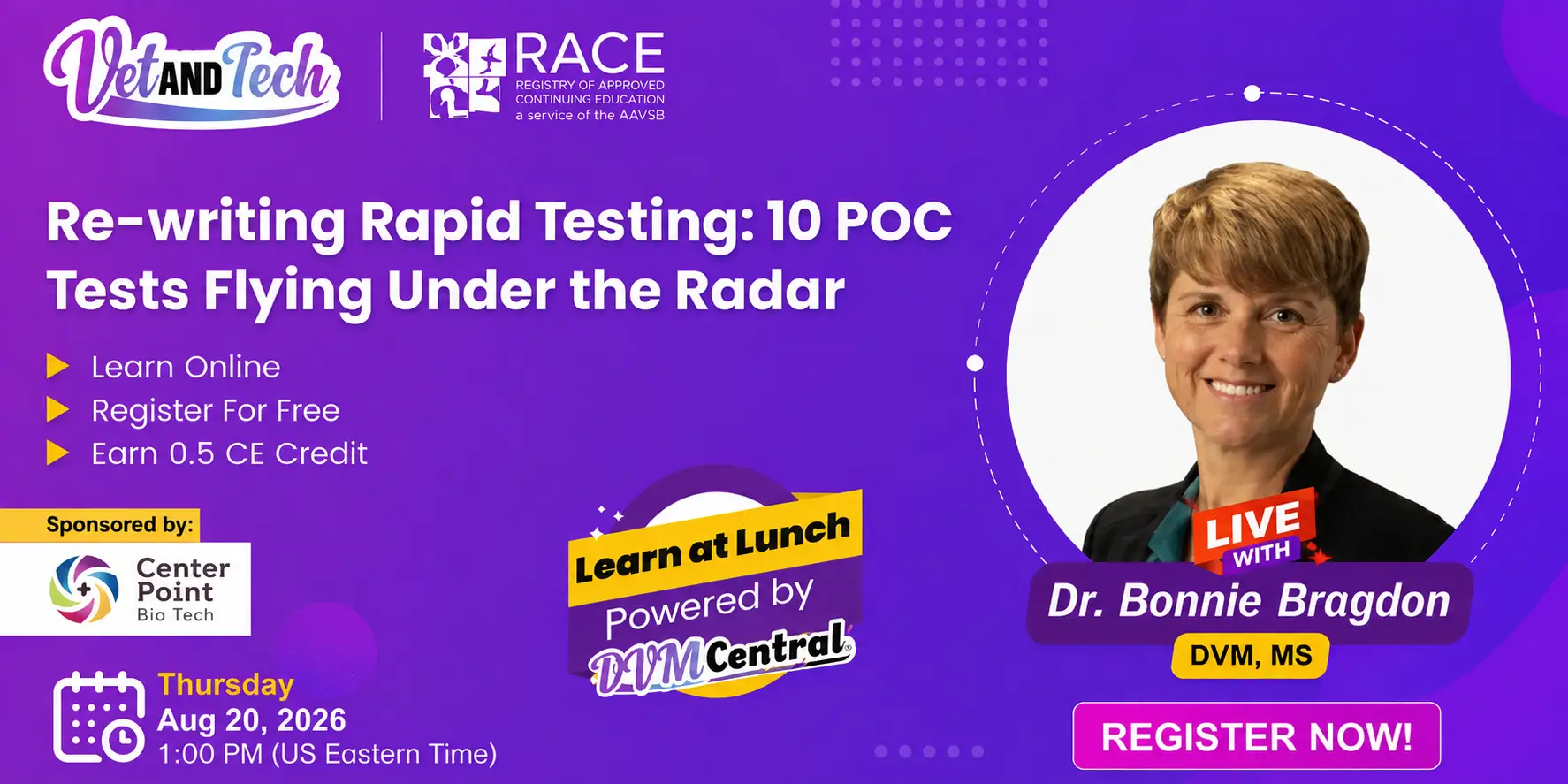 If you want a deeper, more practical breakdown of which point-of-care tests deserve a spot in your clinic's diagnostic lineup, join Vet and Tech for "Rewriting Rapid Testing: 10 POC Tests Flying Under the Radar." Presented by Dr. Bonnie Bragdon, this Learn at Lunch session covers ten POC tests that many clinics may not be using to their full potential, along with practical guidance on where they fit alongside reference lab testing.
Webinar Details:
Date: August 20, 2026
Time: 1:00 PM ET
Category: Internal Medicine
CE credit: 0.5 hours, RACE-approved
The session is ideal for veterinarians, veterinary technicians, practice managers, and veterinary teams looking to improve their in-house diagnostic strategy.
As a participant, you'll have the chance to win one of twenty $50 digital e-gift cards, generously sponsored by Center Point Bio-Tech.
Register now to save your seat and start building a smarter, faster diagnostic workflow for your clinic.
Explore The Vet and Tech Library
The growing library at Vet and Tech offers free live and on-demand webinars that cover everything from diagnostics and inventory strategy to practice management and clinical medicine. Whether you attend live or watch the replay later, you'll gain practical insights you can apply in practice. Explore the full on-demand library on Vet and Tech and keep your team's education moving, on your schedule.
%20VAT%20Blog%20-%20Remote%20Veterinary%20Jobs%20Roles%2C%20Pay%20%26%20How%20to%20Find%20Them-thumbnail-1790256372.webp&w=3840&q=75)


%20VAT%20Blog%20-%20How%20to%20Become%20a%20Relief%20Veterinarian-thumbnail-1788963604.webp&w=3840&q=75)