What Is a Veterinary Scientist? Career Paths, Salary & Research
Key Takeaways:
|
What Is a Veterinary Scientist?
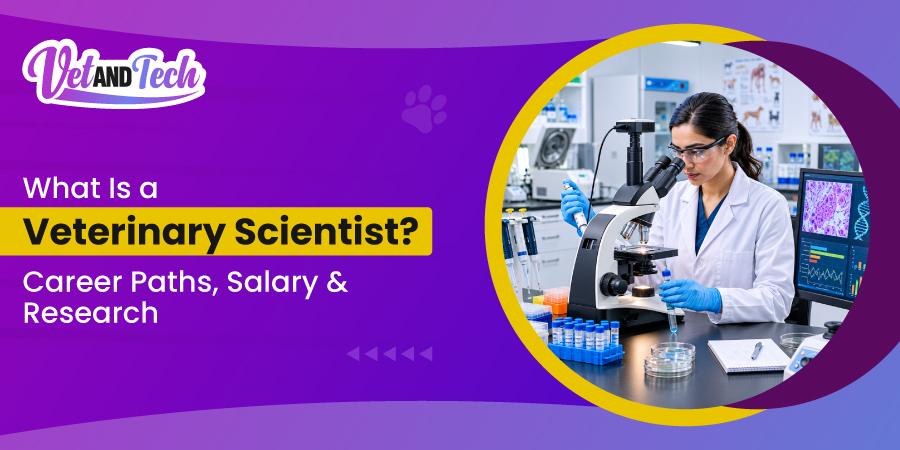
A veterinary scientist studies animal health, disease, and disease prevention. The work comes down to a few big questions. How does a disease develop? How does it spread? What does it do to the animal? And how do you catch it early, treat it, or prevent it altogether?
Veterinary scientists do the behind-the-scenes research that makes treatments possible. They rarely work in the exam room. Instead, they work in labs, universities, and government agencies, building the evidence that veterinarians rely on every day.
Some veterinary scientists also study zoonotic diseases, which are infections that can pass between animals and humans. Their research adds to what we know about disease transmission, diagnostic methods, treatment options, and public health measures.
Veterinary Scientist: Job Description
Veterinary scientists plan experiments and carry out clinical trials. They collect animal tissue samples and analyze data on animal populations.
Some develop and validate diagnostic tests. Many test medicines and vaccines. Others test medical devices for safety.
Part of the job is to observe and report. Outbreak monitoring involves following up on disease outbreaks and reporting findings to the proper authorities.
It all takes place within animal welfare regulations and lab safety standards.
How Veterinary Research Connects Animals, People, and the Environment
One Health recognizes that human, animal, and environmental health are tightly connected, and veterinary science sits right at the center of that link. A few places where it shows up in real research:
- Zoonotic diseases: The CDC estimates that roughly 60% of known infectious diseases in humans are zoonotic. Rabies, avian influenza, and brucellosis are a few examples.
- Vaccine development: Animal studies have supported vaccines for both animals and people.
- Antimicrobial resistance: Researchers track how resistant bacteria move between animals, people, and the environment and how antibiotic use in animals plays into the problem.
- Comparative medicine: Naturally occurring conditions in dogs, cats, and horses, including some cancers and arthritis, help researchers understand similar diseases in humans.
No species lives in isolation. What affects an animal can reach a person, and what affects a person can shape the world around them. Veterinary scientists work at that crossroads, protecting animals, supporting public health, and helping keep ecosystems steady.
Veterinary Science vs. Veterinary Medicine: What’s the Difference?
Both terms sound alike, but the jobs aren’t the same. Veterinary medicine is the clinical profession of examining, diagnosing, and treating animals. Veterinary science is the research that tells clinicians what actually works.
|
Factor |
Veterinary Scientist |
Veterinarian |
|
Main focus |
Research, diagnostics, discovery |
Treating patients |
|
Usual workplace |
Labs, universities, government, industry |
Clinics, hospitals, farms, shelters |
|
Common degrees |
MS, PhD, or DVM plus research training |
DVM or equivalent |
|
License |
Often not required unless practicing clinically |
State license required in the U.S. |
|
Typical output |
Studies, tests, drugs, vaccines, policy data |
Patient care and treatment plans |
|
Closest BLS category |
Medical or biological scientists |
Veterinarians |
So, can a DVM work as a veterinary scientist? Yes. A DVM graduate can move into research. It doesn’t work in reverse, though. A veterinary scientist can’t practice as a veterinary doctor without holding the DVM degree.
Major Research Areas in Veterinary Science
Research areas range from the microscopic to the population level.
- Pathology: Studies how diseases affect animal organs, tissues, and body systems.
- Epidemiology: Looks at how diseases spread among animals and what leads to outbreaks.
- Microbiology and Infectious Diseases: Examines bacteria, viruses, fungi, and parasites that cause animal infections.
- Pharmacology and Toxicology: Studies how medicines affect animals and how toxic substances harm the body.
- Immunology and Vaccinology: Explores how the immune system fights infections and how vaccines protect animals.
- Oncology: Focuses on cancer in animals, including its causes, diagnosis, and treatment.
- Nutrition: Studies how diet and nutrient intake affect animal growth and health.
- Genetics: Examines inherited traits and how genes influence animal health and disease risk.
- Veterinary Public Health: Focuses on diseases that pass between animals and humans and ways to control their spread.
- Food Safety: Studies foodborne diseases linked to animals and ways to protect the food supply.
Research veterinarians usually pick one of these areas and stay with it for years. That depth is what makes their published work so useful to clinicians.
Specialized Veterinary Science Careers
Veterinary scientists can go in many directions, from clinical testing to crime scene investigation.
Here are 5 common jobs and the education they typically need.
|
Career |
Main Focus |
Education |
| Veterinary Research Scientist | Designs and conducts studies on animal diseases, treatments, and biological processes. | Master's or PhD, depending on research responsibilities |
| Veterinary Pathologist | Examines tissues, cells, and other biological samples to diagnose diseases and investigate their causes. | DVM or equivalent, followed by specialized pathology training and certification where applicable |
| Veterinary Epidemiologist | Studies disease patterns, investigates outbreaks, and develops population-level disease prevention strategies. | Master's or PhD in epidemiology or a related field; DVM may be valuable or required for certain positions |
| Veterinary Clinical Pathologist | Interprets laboratory findings from blood, urine, and other samples to support disease diagnosis. | DVM or equivalent, followed by specialized clinical pathology training |
| Laboratory Animal Veterinarian | Oversees the health and welfare of animals used in research and supports institutional animal care programs. | DVM or equivalent, with relevant laboratory animal medicine training |
| Veterinary Biomedical Research Scientist | Investigates cellular, molecular, and biological processes involved in animal diseases and treatment development. | Master's or PhD; DVM may be beneficial for some research positions |
| Veterinary Forensic Specialist | Examines animal injuries, disease findings, and other evidence in investigations involving suspected cruelty or neglect. | Requirements vary by role; veterinary forensic pathology generally requires veterinary and specialized pathology training |
How to Become a Veterinary Scientist
There's no set path. Your path depends on the type of work you want, your qualifications, and where you plan to work. Still, most journeys follow a few familiar steps.
- Start with a bachelor's degree. Biology, animal science, chemistry, microbiology, and biomedical science are the most frequent majors.
- Get into lab work. Seek assistance from a professor, enroll in summer research programs, or obtain a job as a lab technician. Real lab experience is required for graduate programs and employment.
- Choose the course of your graduation. You can pursue an MS, a PhD, a DVM, or a combined DVM/PhD degree.
- Add specialty training. Postdoctoral fellowship and/or residency may be necessary for pathology or laboratory animal medicine and epidemiology.
- Earn a license. You need to have a state veterinary license to practice, but typically not to conduct research in a lab environment. Some specialties also offer board certifications.
- Create a record of publications. Present at conferences and publish in peer-reviewed journals. That's the way to get accepted in the field as a researcher.
Which Pathway Fits You?
Timelines add up fast, so it helps to see the options side by side.
|
Pathway |
Typical Length |
Best For |
| Bachelor's + Master's | Around 5–7 years | Laboratory research and specialized technical positions |
| Bachelor's + PhD | Often 8–10+ years | Independent research, academic science, and research leadership |
| Undergraduate preparation + DVM | Commonly around 8 years | Clinical veterinary practice and research involving clinical care |
| DVM + additional PhD or residency | Often 10–12+ years | Advanced veterinary research and specialist careers |
Want practical lab work? The BS plus MS is the quickest way into the field. A PhD suits you better if you plan to lead research or teach at a university. And if you want to work with patients and run studies too, the DVM plus PhD or residency is the longest path, but it opens the widest range of opportunities.
Veterinary Scientist Salary and Jobs
So how much does a veterinary scientist earn? The Bureau of Labor Statistics (BLS) doesn’t list “veterinary scientist” as its own occupation, so the figures below come from the nearest categories. Treat them as benchmarks. Actual pay depends on degree, experience, specialty, employer, location, and whether the job requires a veterinary license.
|
Occupation (BLS) |
Measure |
Figure |
Data Year and Scope |
|
Medical scientists, except epidemiologists |
Median annual wage |
$103,410 |
May 2025, U.S. national |
|
Biological scientists, all other |
Median annual wage |
$98,920 |
May 2025, U.S. national |
|
Veterinarians |
Median annual wage |
$130,100 |
May 2025, U.S. national |
According to the BLS, employment of medical scientists is projected to grow by 13% between 2025 and 2035. This projection applies to the medical scientist occupation as a whole, not specifically to veterinary scientists. The highest-paid jobs are in pharmaceutical or medical manufacturing. Positions at universities and government are less paid but more stable, with support and benefits.
Common occupations are university research scientist, diagnostic laboratory scientist, reference lab pathologist, USDA or FDA regulatory scientist, or drug development scientist at an animal health company.
A Short History of Veterinary Science
It began with a practical problem: sick animals. Over centuries, the field evolved into the research and development of vaccines and treatments for disease. Here are the hallmarks of its evolution.
1761: The first veterinary school was established in Lyon, France, by Claude Bourgelat. The school was established following widespread outbreaks of the cattle plague (rinderpest) in Europe.
1791: Veterinary education reaches London. The Royal Veterinary College was established in London, one of the first colleges to provide a structured veterinary education.
1863: AVMA is founded. The American Veterinary Medical Association was founded in the United States for the representation of the veterinary profession in America.
1879: First public veterinary college in the United States. Iowa State established the first public veterinary college in the United States, thus providing a formal education for veterinarians.
1885: Pasteur is credited with developing the rabies vaccine. Louis Pasteur's development of the rabies vaccine was a major advance in vaccine development. It also demonstrated the benefits of animal research in advancing human health.
2011: Rinderpest declared eradicated. Rinderpest was declared eradicated worldwide by the World Organization for Animal Health (WOAH) and the Food and Agriculture Organization (FAO). It is the second disease wiped out in the whole world, after smallpox.
Final Note
There are lots of ways in. Some go on to get a graduate degree in a biomedical field, others get a DVM, or they combine veterinary and research training.
If this is the kind of career that appeals to you, start small. Try to find research opportunities at local universities.
Talk to people who work in veterinary labs. Look into graduate programs in your area of interest. These steps will expose you to the opportunities a career in veterinary science has to offer.
FAQs
What qualifications do you need to become a veterinary scientist?
Most veterinary scientists hold a master’s degree or PhD in veterinary science, microbiology, pathology, immunology, or a related field. A DVM is also valuable for roles that combine research with clinical practice.
What challenges do veterinary scientists face?
Limited research funding, difficulty collecting samples, variation in study results, and the complexity of doing research in clinical settings.
How is a veterinary scientist different from a veterinarian?
A veterinary scientist focuses mainly on research into animal health and disease. A veterinarian diagnoses and treats animals.
What jobs can you get with a veterinary science degree?
Graduates may work as research scientists, laboratory scientists, veterinary pathologists, epidemiologists, pharmaceutical researchers, or public health researchers. The options depend on your qualifications and experience.
What are some common veterinary scientist jobs?
Typical roles include university research scientist, diagnostic laboratory scientist, reference lab pathologist, regulatory scientist at the USDA or FDA, and drug development scientist at an animal health company.