

Sedation in Birds: When to Choose It Over Anesthesia
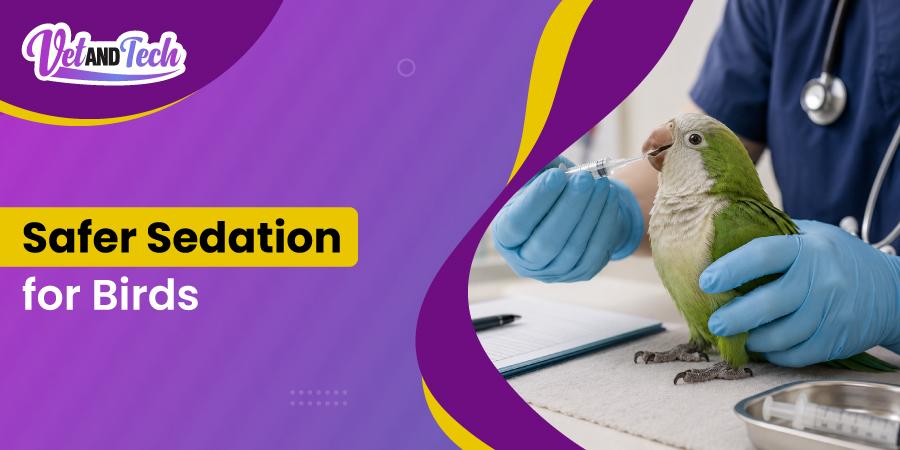
Sedation in birds is a safer alternative to general anesthesia for minor procedures and diagnostic handling. It reduces stress, preserves spontaneous breathing, and allows faster recovery compared to anesthesia.
Veterinarians commonly use sedation for imaging, blood collection, and minor interventions where full unconsciousness is not required.
Avian medicine has long operated at two extremes: manual restraint of a conscious bird and general anesthesia. It has been noted that restraining a bird while examining or sampling causes severe stress accompanied by hypothermia. General anesthesia for birds is acceptable for invasive procedures only.
Between these two extremes, a safer intermediate approach is needed to allow comfortable and secure examination of birds.
Today, procedural sedation is increasingly used in avian medicine as an alternative to anesthesia. Procedural sedation offers a more favorable safety margin and a quicker return to normal behavior.
Veterinarians must understand the importance of sedation in birds, when to administer it, and how sedation is a better approach than anesthesia.
What is Sedation in Birds?
Sedation in birds is the controlled use of medications to reduce stress, movement, and awareness while maintaining consciousness and spontaneous breathing. It is commonly used for minor procedures and diagnostic handling in avian patients.
Physical Restraint and General Anesthesia: Understanding the Two Extremes
Manually restraining a bird is simple, but it carries well-documented physiological effects. Studies confirm that restraint in birds significantly elevates body temperature and respiratory rate. Stress responses due to manual restraint can be harmful in sick patients.
The unfamiliar clinic environment can trigger a fear response that can become a clinical emergency within seconds.
General anesthesia, meanwhile, carries its own risks. Isoflurane remains the veterinary anesthetic of choice for most avian procedures. Isoflurane, the most commonly used avian anesthetic, may cause cardiovascular and respiratory depression in avian patients. There is a clinically significant risk of aspiration of gastric or crop contents, and hypothermia is a persistent hazard.
Unlike mammals, birds lack a diaphragm and rely on thoracic musculature for respiration, making birds more sensitive to anesthesia. That’s why every minute under anesthesia is a physiological risk for birds.

Procedural Sedation in Birds: A Safer Clinical Approach
Sedation of pet birds helps reduce the risk of complications by minimizing the stress and adverse effects associated with manual restraint.
Clinical Background of Sedation in Birds
Sedation is generally considered safe when properly selected and dosed. However, the shift towards procedural avian sedation is recent. A study on sedation in birds outlines the following advantages of this approach.
- Less stress as compared to manual restraint in minor surgical procedures for birds
- Lower risk of cardio-respiratory depression compared to general anesthesia
- Safer for routine procedures (blood draw, imaging)
- Improves handling and exam accuracy
- Reduces injury risk to birds and staff
- Limits fear and negative clinic conditioning
- Preserves spontaneous breathing in most cases
- Fast onset with dose-controlled effects
- Often fully reversible, allowing quick return to normal behavior
- Can be given via noninvasive routes (e.g., intranasal)
- Improves overall clinical efficiency
- Supports quicker post-procedure recovery
Drugs for Procedural Sedation in Birds
The most common drugs used by veterinarians for avian sedation are midazolam, diazepam, and butorphanol. Here are the details.
|
Drug |
Route of Administration |
Effects |
|
Midazolam |
Intranasal, intramuscular |
Sedative drug for birds, muscle relaxant, anxiolytic, amnestic, appetite-stimulating; widely used with a high safety margin |
|
Diazepam |
Intranasal (preferred), intramuscular (less preferred) |
Sedative and anxiolytic effects; longer onset and duration than midazolam; alternative when midazolam is unavailable |
|
Butorphanol |
Intranasal, intramuscular, parenteral |
Opioid analgesic with mild sedative effects; sedation is enhanced when combined with benzodiazepines; used for deeper sedation and analgesia |
Sedation Reversal in Birds
Reversal of sedation in bird pets depends on both the patient’s condition and the clinical purpose of sedation. Veterinarians must be well-informed about bird diseases and symptoms before administering sedation.
Veterinarians commonly use flumazenil (a benzodiazepine antagonist) to reverse the sedation effects in birds.
Sedated birds should be reversed promptly so they can return to normal behavior and feeding as soon as possible. Discharging a partially sedated patient is not recommended, as residual effects may leave the bird unsteady, drowsy, and reluctant to eat, outcomes that can be distressing for owners and unsafe for the patient.
In contrast, birds sedated for procedures such as e-collar application, bandaging, or seizure control are typically not reversed. These cases require continued monitoring, with reversal considered only if sedation becomes excessively deep or prolonged or if it begins to interfere with essential physiological functions, particularly feeding behavior.
When to Choose Sedation Over Other Methods?
The choice between sedation and anesthesia is based on clear clinical criteria. Sedation is typically preferred when full immobilization or deep analgesia is not required.
It is also required when general anesthesia poses a higher risk for the patient. Veterinarians can also use sedation to support examination while allowing a quick return to normal feeding and behavior afterward.
Here’s when veterinarians can choose sedation over other methods.
- Physical examination in fractious birds
- Radiographic positioning
- Blood collection and venipuncture
- Diagnostic sample collection
- Splint or bandage application
- Minor wound care and cleaning
- Nail and beak trimming
- Feather or skin biopsy
- Ultrasound examination
- Mass removal with local block
Understanding when to choose sedation over anesthesia is essential for improving patient safety and procedural outcomes in avian practice.
To explore real clinical applications, protocol selection, and case-based decision-making, join our upcoming webinar, “Sedation as an Alternative to Anesthesia in the Avian Patient.” This session will provide practical insights into safely using sedation in birds for common procedures.
Register for the avian sedation webinar
Sedation vs Anesthesia vs Restraint in Birds (Clinical Comparison)
|
Feature |
Procedural Sedation |
General Anesthesia |
Manual Restraint |
|
Consciousness |
Reduced but retained, the bird may respond to strong stimuli |
Fully unconscious; no response to stimulation |
Fully conscious; fully aware of handling |
|
Respiratory risk |
Minimal at standard dosages; spontaneous ventilation maintained |
Significant respiratory depression possible; intubation and monitoring required |
Stress-induced tachypnea or respiratory compromise is possible |
|
Reversibility |
Fully reversible (e.g., with flumazenil); rapid return to normal behavior |
Requires metabolism; variable recovery time; risk of hypothermia during recovery |
No pharmacologic reversal; recovery depends on restraint release and physiology |
|
Route of administration |
Intranasal (preferred) or intramuscular; no IV access required |
Inhalation (e.g., isoflurane) or injectable; equipment-dependent |
No pharmacologic administration |
|
Ideal for |
Diagnostics, radiography, minor procedures, blood collection, grooming |
Invasive surgery or procedures requiring complete immobility or long duration |
Very brief, low-stress handling tasks in calm patients |
|
Analgesia (if present) |
Provided by adjunct agents (e.g., butorphanol); local blocks may extend coverage |
Inhalants provide no intrinsic analgesia; additional analgesics are required |
None; relies on physical control only |
Clinical Considerations for Sedating Birds
General considerations for sedating birds in clinical practice that veterinarians may use safely and effectively.
- Explain the sedation process to the pet owner and set expectations for temporary drowsiness and possible mild side effects.
- Gently restrain the bird to minimize stress during administration.
- Administer the sedative agent via the appropriate route, such as intranasal or intramuscular.
- Release the bird and allow time for the full sedative effect in a safe environment without perching.
- Monitor vital signs during the procedure.
- After the procedure, administer a reversal agent based on clinical judgment and protocol.
- Monitor recovery in a secure area until the bird is fully alert before discharge.
Although increasingly adopted, this approach requires careful clinical judgment and monitoring.
Upcoming Webinar on Avian Sedation and Anesthesia Alternatives
Join our upcoming expert-led webinar, Sedation as an Alternative to Anesthesia in the Avian Patient, to gain in-depth clinical insight into modern sedation practices in birds.
Scheduled for May 13, 2026, this RACE-approved session offers 1 CE credit and is designed for veterinarians and avian clinicians seeking practical, evidence-based guidance.
Learn when sedation can be safely preferred over general anesthesia, explore commonly used sedative agents, and understand administration techniques, monitoring, and recovery protocols.
The course, led by Angela M. Lennox, will also cover clinical scenarios, risk–benefit considerations, and practical applications in psittacine patients. If you want to learn complete sedation protocols in birds from an expert perspective, this session is recommended for veterinarians seeking advanced clinical insight.
Strong expertise in avian sedation and clinical handling is increasingly valued in avian veterinary jobs and exotic practice settings.
Registration is open for interested participants.
Key Takeaways
- Sedation is ideal for minor avian procedures and diagnostics
- It reduces stress and preserves spontaneous breathing
- Safer than anesthesia when full unconsciousness is not required
- Common drugs include midazolam and butorphanol
- Proper case selection is critical for safety
Conclusion
Procedural sedation is emerging as a valuable middle ground in avian practice, offering a safer and less stressful alternative to manual restraint and general anesthesia for appropriate cases. It supports smoother handling, stable physiological function, and quicker recovery, particularly in diagnostic and minor procedures.
Its effective use, however, depends on sound clinical judgment and proper case selection, ensuring it is chosen only when truly indicated. With careful application, sedation can meaningfully improve both patient welfare and clinical efficiency in avian medicine.
FAQs
Can birds feel pain during sedation?
Sedation reduces awareness and stress; pain control depends on adjunct analgesics.
What are the risks of sedation in birds?
Risks are generally low but may include cardiovascular and respiratory depression, hypothermia, and regurgitation/aspiration. An overdose can be lethal for birds.
What drugs are commonly used for bird sedation?
Midazolam, diazepam, and butorphanol are most commonly used in avian sedation.
What is the difference between sedation and anesthesia in birds?
Sedation reduces awareness while the bird remains conscious. On the other hand, avian anesthesia causes complete unconsciousness and loss of response.
Is sedation safer than anesthesia for birds?
Yes, sedation is generally safer than anesthesia for birds in minor procedures because it preserves breathing and reduces recovery time when properly administered.
When to choose sedation over anesthesia in birds?
Sedation is preferred for non-invasive procedures. Veterinarians can sedate birds during physical exams and sample collection. Sedation is also recommended for imaging and minor clinical interventions. For detailed info, watch our CE webinar on Avian sedation.


%20VAT%20Blog%20-%20How%20to%20Become%20a%20Relief%20Veterinarian-thumbnail-1788963604.webp&w=3840&q=75)