




Stomatitis in Cats: Its Causes, Diagnosis, and Treatment
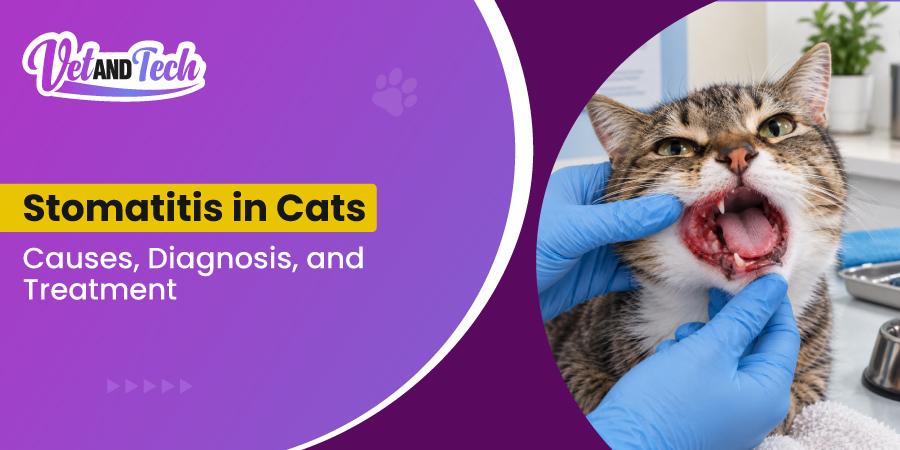
A cat presents with a week-long history of drooling. Her owner reports that she has been dropping kibble while eating, has stopped grooming, and has developed foul-smelling breath. Red, swollen gums that bleed with gentle contact are familiar findings in feline patients with stomatitis, particularly feline chronic gingivostomatitis (FCGS). For veterinarians, these signs can raise suspicion of a broader inflammatory condition affecting the oral cavity.
The inflammation can be severe, and by the time a cat reaches the exam room, weight loss may already be present. What makes the disease challenging is its unpredictable course. Its underlying cause is not fully understood, and cats with similar lesions may respond very differently to the same treatment plan.
What Is Stomatitis in Cats?
Stomatitis is a chronic inflammation of the mouth lining in cats. It may extend beyond the gingiva into the caudal oral cavity, palatoglossal folds, and buccal and labial mucosa. It is closely related to gum disease and periodontal disease, but it is not the same thing.
In cats, stomatitis is usually characterized by severe inflammation with only small amounts of plaque, and the inflammation quickly recurs after routine cleaning.
Two clinical patterns are often called Type 1 and Type 2.
- Type 1: It involves the alveolar and labial or buccal mucosa and has a better prognosis.
- Type 2: It involves the caudal oral cavity, with or without involvement of the alveolar and buccal mucosa, and is usually more difficult to control.
Causes of Stomatitis in Cats: How Do Cats Get Stomatitis?
The causes of stomatitis in cats are multifactorial. Current research suggests that feline stomatitis involves an exaggerated immune response to antigens in the oral cavity, with CD8-positive T cells playing a role. Chronic viral infections, inflammatory cytokines such as IL-6 and IL-17, and bacterial plaque have also been linked to the condition.
So when owners ask how cats get stomatitis, there is no single cause to point to. The disease appears to develop when a susceptible immune system reacts strongly to the ongoing presence of oral bacteria and other antigens.
|
Contributing factor |
Clinical relevance |
|
Feline calicivirus (FCV) |
Chronic infection is strongly associated with FCGS. Coinfection with FCV and feline foamy virus is reported in about two-thirds of cats that fail extraction. |
|
FeLV and FIV |
Immune compromise raises risk. Retroviral status can also affect prognosis. |
|
Plaque and calculus |
Bacterial biofilm on tooth surfaces drives the immune overreaction. |
|
Bartonella henselae |
Reported in some affected cats, but also found in many unaffected cats. |
|
Trauma, toxins, systemic disease |
Can cause secondary oral lesions and a mouth infection in cats that mimics FCGS. |
Not every FCV-, FeLV-, or FIV-positive cat develops stomatitis, and not every stomatitis case has a viral trigger.
Treatment for Stomatitis in Cats: How Is It Treated?
Stomatitis symptoms in cats often begin subtly. Owners may report only bad breath or a mild change in chewing. Weight loss and a poor coat can follow when the cat stops grooming.
|
Stage |
Typical findings |
|
Mild stomatitis in cats / early feline stomatitis |
Gingival redness, halitosis, mild hypersalivation, slight reluctance to chew hard food. |
|
Moderate |
Bleeding gums, proliferative or ulcerated lesions, drooling, dropping food, pawing at the mouth. |
|
Severe stomatitis in cats |
Widespread ulceration, marked pain on opening the mouth, anorexia, weight loss, unkempt coat, behavior change. |
Stomatitis Diagnosis: Building the Workup
There is no single confirmatory test, so stomatitis diagnosis rests on history, a complete oral examination, and exclusion of other diseases. A practical workup includes:
- A conscious oral exam followed by a full oral exam under general anesthesia.
- Full mouth dental radiographs to identify retained roots, resorption, and bone changes.
- CBC, chemistry, urinalysis, and FeLV and FIV testing.
- Consideration of FCV and other viral testing when it will change management.
- Biopsy of proliferative or asymmetric lesions to rule out squamous cell carcinoma and eosinophilic granuloma complex.
Also differentiate FCGS from juvenile periodontitis, metabolic disease, and neoplasia, because therapy and prognosis differ greatly.
Treatment for Stomatitis in Cats: How to Treat Stomatitis in Cats
Dental extraction is a key component of treatment for many cats with FCGS. Partial mouth extraction (all premolars and molars) or full mouth extraction gives the best long-term results. Any tooth with adjacent inflamed mucosa should be removed, including canines and incisors when involved. Complete root removal is essential, and post-operative radiographs confirm it.
Because the surgery can be extensive, pain control is usually approached with multiple strategies. Regional nerve blocks with buprenorphine may be used alongside perioperative opioid or ketamine infusions to provide pain relief during and after the procedure.
Medical treatment may also continue alongside surgery, as some cats remain symptomatic after surgical intervention. Cats that test positive for FCV, FeLV, or FIV may particularly benefit from a combined surgical and medical approach.
|
Option |
Role and evidence |
|
Extraction |
Published studies report varying outcomes. Some reviews report substantial improvement or resolution in approximately 70% to 80% of cats, while individual studies have reported approximately 28% complete resolution and 39% substantial improvement. |
|
Cyclosporine |
For refractory cases. Whole blood levels above 300 ng/mL were linked to the best response. Effects can appear within about 4 weeks. Vomiting and diarrhea are common. Best in indoor cats. |
|
Recombinant feline interferon omega |
Immunomodulator. A 2025 study combined it with cyclosporine after extraction and suggests it as an option when steroids or stem cells are not feasible. |
|
Mesenchymal stem cells |
Up to 57 percent (allogeneic) and 71 percent (autologous) improvement or remission in refractory cases. No response was seen when given before extraction. |
|
Corticosteroids and NSAIDs |
Short-term pain and inflammation control. Long-term prednisone risks include diabetes and heart disease. |
Antibiotics for Stomatitis in Cats
Antibiotics for stomatitis in cats are supportive, not curative. They can reduce bacterial load, inflammation, and pain during flare-ups. They are not advised long-term, and extraction plus prolonged antibiotics alone often fails to resolve disease. Use them with stewardship in mind and pair them with definitive dental therapy.
Home and Adjunct Care
Good dental care after healing helps. Soft diets during recovery, pain control, and regular rechecks help maintain cat oral health. Owners of cats with residual disease may also be advised on gentle plaque control.
Feline Stomatitis Prognosis
The feline stomatitis prognosis varies from one patient to another. Treatment can bring substantial relief, although not every cat responds in the same way. Across published studies, roughly 30% of cats achieve complete remission, while about 40% have a partial response. The remaining 20% to 30% may continue to experience signs despite standard treatment.
For cats that respond well, the change can be noticeable. As oral pain settles, they often start eating more comfortably and become more active. Some cats are able to return to dry food even after having most or all of their teeth removed.
The 2025 combined interferon and cyclosporine study found that pre-extraction disease scores did not reliably predict outcome. Evaluation six months after a three-month immunomodulatory course gave a reasonable estimate of long-term prognosis. Set expectations early, explain that lifelong monitoring may be needed, and schedule rechecks.
Is Feline Stomatitis Contagious? Kitten and Fungal Stomatitis
Feline stomatitis syndrome itself is an immune-mediated inflammatory disease and is not considered contagious. However, FCV, feline herpesvirus, FeLV, and FIV can spread between cats, so multi-cat households need a sensible testing and vaccination plan.
Kitten stomatitis deserves a broader differential list, including FCV infection and juvenile-onset periodontitis. Test for retroviruses and take radiographs.
Fungal stomatitis in cats may develop and is usually caused by Candida albicans and appears as creamy white, flat plaques on the mucosa. It is more likely in cats with underlying disease or prior antimicrobial or immunosuppressive therapy, and it needs a different approach from FCGS.
A Note for Pet Parents
If your cat drools, smells foul, drops food, or stops grooming, book a vet visit promptly. Cats hide pain, and early cat dental problems are far easier to treat than advanced disease. Stomatitis is hard to prevent, but routine dental checks, vaccination against FCV, feline herpesvirus, and FeLV, and quick attention to oral changes all help.
Free Veterinary Dentistry Webinars from Vet and Tech
Managing FCGS demands current knowledge of extraction technique, dental radiography, and pain management. VetandTech offers free, RACE-approved veterinary dentistry webinars with recognized specialists, live and on-demand, that earn CE credit for veterinarians and technicians. Browse the schedule and register at Vet and Tech to sharpen your feline dental skills at no cost.
FAQs
Can stomatitis in cats be cured?
Some cats go into complete remission after dental extraction, while others have a partial response and may still need medical treatment. A smaller number continue to have signs and may need long-term management.
Are antibiotics enough to treat stomatitis?
Usually not. Antibiotics may be prescribed when there is a secondary bacterial infection or during certain flare-ups, but they do not address the underlying inflammatory process. Dental extraction is a key part of treatment for many affected cats.
Do all cats with stomatitis have FeLV or FIV?
No. FeLV and FIV can be associated with feline stomatitis, but many cats with the condition test negative for both viruses. Testing can still provide useful information when investigating an individual patient.
How soon do cats improve after extraction?
Recovery varies between cats. Some begin eating more comfortably within the first few weeks as the mouth heals, while others take longer to show noticeable improvement.
Is feline stomatitis painful?
Yes. Feline stomatitis can cause substantial oral pain, which may affect eating, grooming, and daily behavior. Pain relief should therefore be included as part of the treatment plan.


%20VAT%20Blog%20-%20Remote%20Veterinary%20Jobs%20Roles%2C%20Pay%20%26%20How%20to%20Find%20Them-thumbnail-1790256372.webp&w=3840&q=75)

